Southeast Asia's Quiet Green Revolution: How 78% Are Going Eco Without Breaking the Bank
When you're battling a cost-of-living crisis, going green might sound like a luxury. Southeast Asians are proving otherwise.
Picture this: You're struggling with grocery bills that seem to climb every week. Your rent just went up. Job security feels shakier than ever. Now everyone is telling you to "go green" and save the planet. You want to be part of the agenda, but while you worry about the planet, you’re worrying about yourself first.
Yet across Southeast Asia in 2025, something remarkable is happening. Despite 75% of the region citing cost-of-living as their biggest worry, 78% of Southeast Asians adopted environmentally-friendly habits this year. In some countries, that number hits 87%.
This isn’t greenwashing. This isn’t virtue signaling. This is a ground-up environmental movement happening in one of the world's most economically pressured regions—and it’s rewriting the rules about who can afford to care about the planet.
The Pragmatic Environmentalist
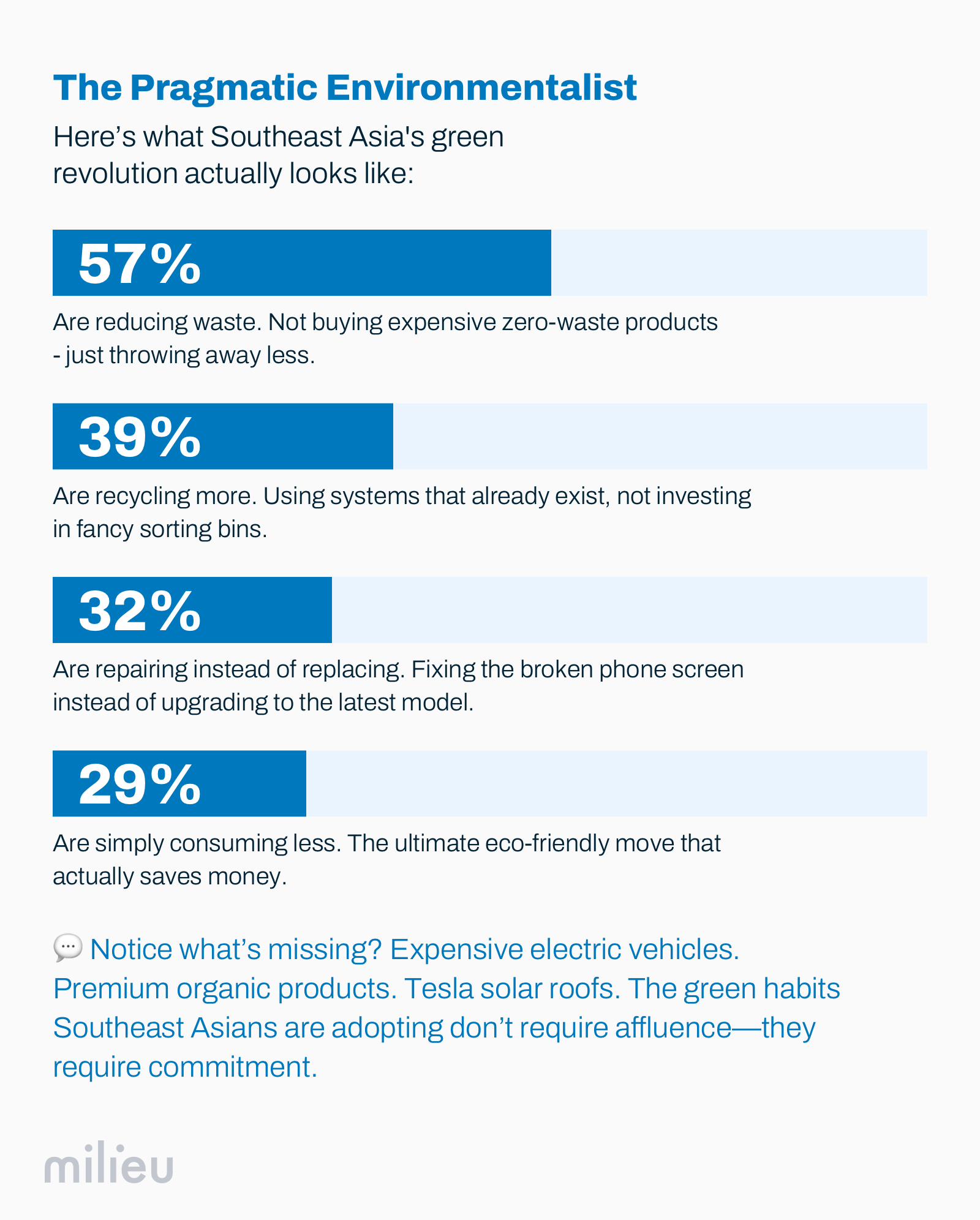
Here’s what Southeast Asia's green revolution actually looks like:
- 57% are reducing waste. Not buying expensive zero-waste products—just throwing away less.
- 39% are recycling more. Using systems that already exist, not investing in fancy sorting bins.
- 32% are repairing instead of replacing. Fixing the broken phone screen instead of upgrading to the latest model.
- 29% are simply consuming less. The ultimate eco-friendly move that actually saves money.
Notice what’s missing? Expensive electric vehicles. Premium organic products. Tesla solar roofs. The green habits Southeast Asians are adopting don’t require affluence—they require commitment.
When Sustainability Meets Survival
There’s another driver: 35% of Southeast Asians listed natural disasters and climate relief as a top-three concern in 2025. In Thailand, that jumps to 49%. In the Philippines, 45%.
These aren’t abstract future threats. Typhoons, floods, droughts—Southeast Asia is on the climate crisis frontlines. When disaster preparedness is your daily reality, environmental action stops being theoretical.
- You reduce waste because you’ve seen what floods do to communities buried in trash.
- You repair instead of replace because you understand resource scarcity.
- You consume less because you’ve watched consumption patterns contribute to disasters affecting your neighbors.
This is environmentalism born from lived experience.
The Wealth Paradox
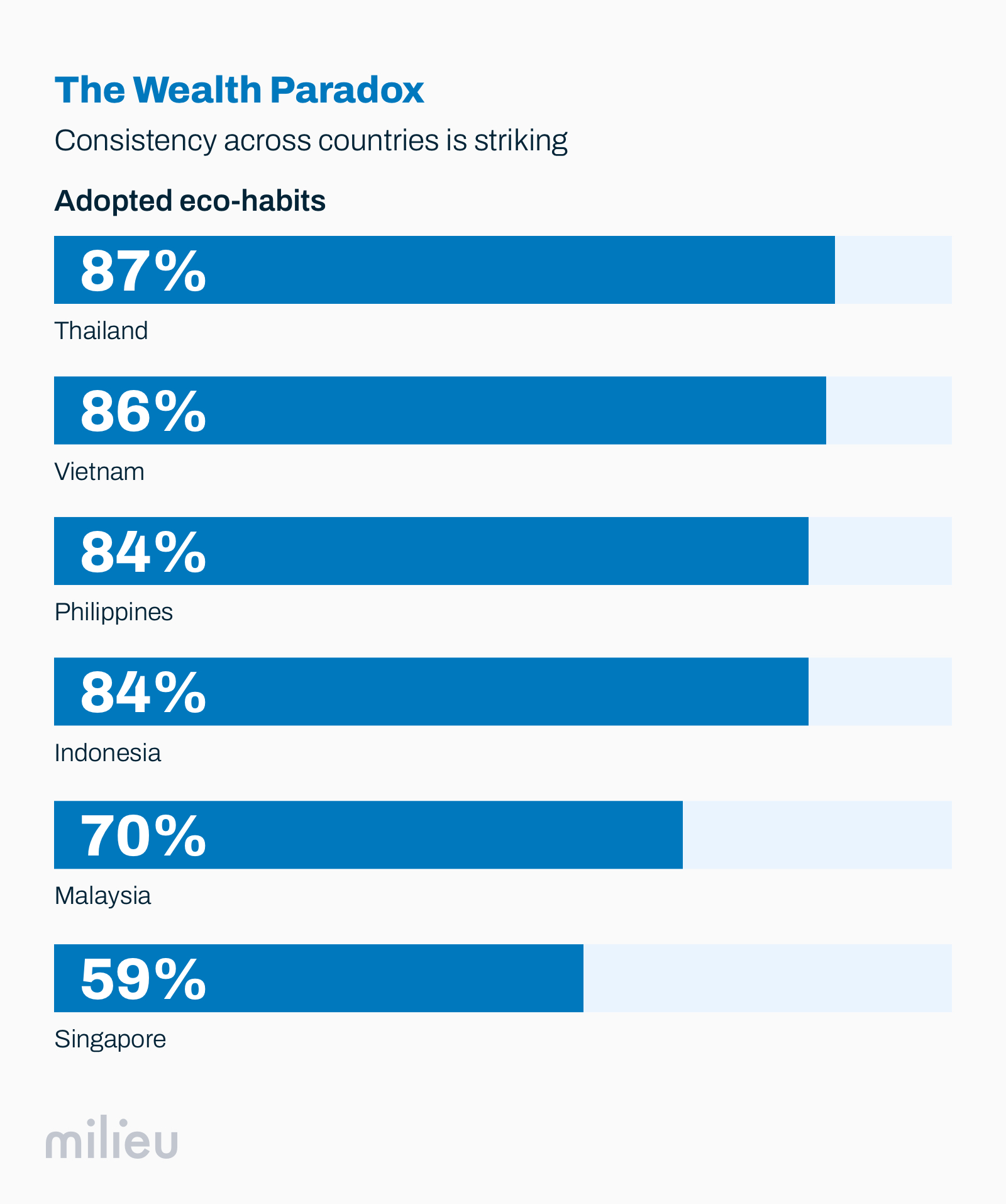
Consistency across countries is striking:
- Vietnam: 86% adopted eco-habits
- Thailand: 87%
- Philippines: 84%
- Indonesia: 84%
- Malaysia: 70%
- Singapore: 59%
Interestingly, Singapore—the wealthiest nation surveyed—shows the lowest adoption rate. Environmental action in Southeast Asia isn’t correlated with wealth. It’s correlated with necessity and community awareness.
Even spending choices reflect pragmatism:
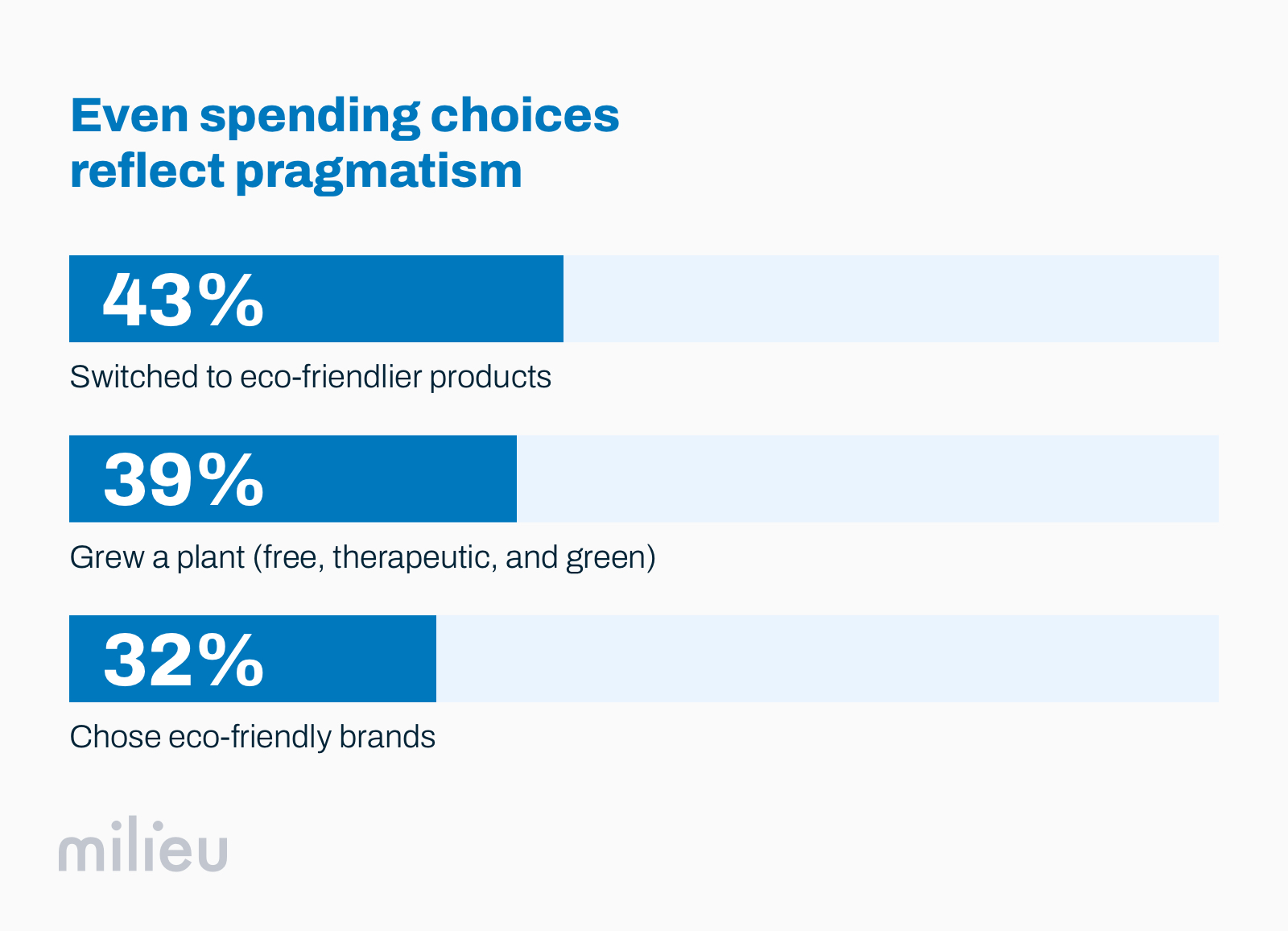
- 43% switched to eco-friendlier products
- 32% chose eco-friendly brands
- 39% grew a plant (free, therapeutic, and green)
These choices are practical—switching products as they need replacement, choosing eco-brands when price-comparable, growing plants that provide food or joy alongside their environmental benefit.
The Repair Culture Renaissance
One of the most fascinating findings: 32% of Southeast Asians are repairing rather than replacing products, with some countries like the Philippines hitting 46%.
This represents a cultural shift away from disposability that took root during decades of consumer capitalism. By choosing repair, Southeast Asians are:
- Keeping products out of landfills
- Preserving repair skills and craftsperson livelihoods
- Reducing demand for new manufacturing and its carbon footprint
- Saving money while being green
It’s a rare quadruple win—environmental, economic, cultural, and practical.
Why This Matters Beyond Southeast Asia
If 78% of Southeast Asians can adopt environmental habits while battling cost-of-living crises, unemployment fears, and health concerns, what’s everyone else’s excuse?
The region is demolishing the myth that you need economic stability before you can care about the planet. Environmental action doesn’t require premium pricing—it requires prioritization.
With over 600 million people, Southeast Asia demonstrates a scalable model for sustainable development worldwide. Sometimes the most innovative environmental solutions aren’t about what you can buy—they’re about what you choose not to throw away.
The Message
As 2025 progresses, Southeast Asia’s green revolution shows no signs of slowing. With climate impacts intensifying and economic pressures mounting, the region proves that environmental consciousness and economic constraint can coexist—and even reinforce each other.
The message is clear: going green isn’t about affording a Tesla. It’s about respecting resources, reducing waste, repairing what breaks, and recognizing that the planet doesn’t care about your income bracket.
78% of Southeast Asians get it. The rest of the world might want to take notes.
About the study: Based on a SEA Social Issues 2025 Study of almost 3,000 respondents across Singapore, Thailand, Malaysia, Indonesia, Vietnam, and the Philippines, conducted by Milieu Insight.

Author
Milieu Team
At Milieu, we’re a team of curious minds who love digging into data and uncovering what drives people. Together, we turn insights into stories—and stories into action. We also run on coffee, deadlines, and the occasional meme.
Latest Insights