People Care About Sustainability. They Just Don’t See The Full Picture.
Every April, Earth Day arrives with its familiar rituals: reusable bags, pledges to recycle more, and brands turning their logos green. But a new study by Milieu Insight, surveying 900 respondents across Singapore, Malaysia, and Thailand, suggests that the real barrier to a more sustainable world isn’t apathy. It’s a knowledge gap — and it may be quietly undermining everything else.
The cost hiding in plain sight
Ask most people whether they’re aware that AI has an environmental impact, and many will nod along. But ask them exactly how much, and the picture gets blurry fast.
Our study found that only 29% of respondents correctly identified that using an AI chatbot is estimated to consume significantly more energy — in some cases up to 10 times more — than a standard Google search. The majority (71%) either underestimated the difference or assumed both use roughly the same amount of energy. In Thailand, that figure was even starker: 42% believed there was no difference at all.

This isn’t a small gap. It’s a blind spot in how we understand the environmental cost of our digital lives. Every time someone uses an AI tool — to draft an email, generate an image, ask a question — they’re tapping into data centres that consume vast amounts of electricity and water. Some hyperscale data centres, for instance, are estimated to use the equivalent of several Olympic swimming pools’ worth of water each day.
And yet, to most users, that cost is invisible. The interface is clean, the response is instant, and the carbon is somewhere else entirely. The issue isn’t that people don’t care. It’s that they’re making decisions without the full picture. In Malaysia, 28% of respondents said they honestly don’t know where to start on sustainability — the highest of any market surveyed.
The case for making companies show their work
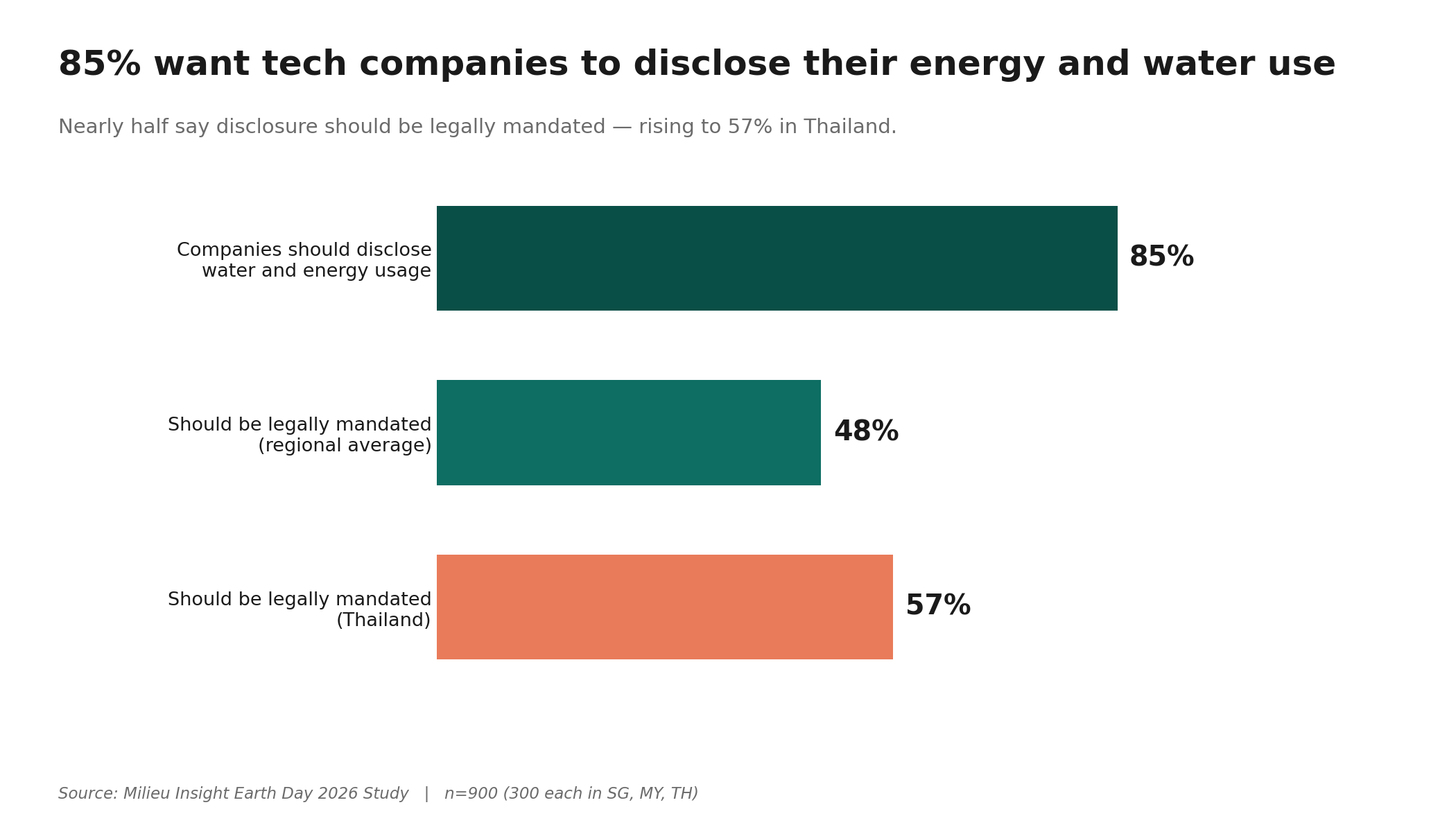
Across all three markets, 85% of respondents said they believe companies — particularly big tech firms and data centre operators — should disclose their water and energy usage. Nearly half (48%) said this transparency should be legally mandated, not left to voluntary commitments. In Thailand, that figure rose to 57%.
The demand comes at a time when sustainability reporting is becoming more common, but not always more useful. While major tech companies do publish annual reports, the depth and consistency of disclosure still vary widely. Some share only aggregate figures, others limit reporting to owned sites, and some omit absolute consumption data altogether.
Even institutional investors have begun pushing for more granular, standardised reporting ahead of shareholder meetings. The public, it seems, is asking a similar question: if the environmental cost is real, why is it still so difficult to measure?
Making it easy to do the right thing
Knowledge matters. Accountability matters. But there’s a third piece to this puzzle, and it may be the most human of all.
When asked what single change they would most want to see by next Earth Day, the top answer — chosen by 40% of respondents — wasn’t stricter laws, or regional agreements, or even better education. It was more accessible green choices in everyday life.

That answer speaks volumes. It reflects a common frustration: wanting to do better, but finding the path blocked by price, inconvenience, or lack of options. Sustainable products often come at a premium. Public transport doesn’t always go where it’s needed. Recycling systems can be confusing or inconsistent. The result is a feeling that living sustainably requires either sacrifice or privilege, and sometimes both.
The gap between intent and action is real. In Singapore, 58% of respondents said they plan to reduce their home energy or water usage in the next six months — the highest of any market in the study. Yet in the same breath, 12% said they don’t expect to change anything at all, and 18% said they’ve thought about it but haven’t yet acted. Even among the most motivated, the barriers are real.

Awareness campaigns and carbon pledges can only go so far if the default choices people face remain unsustainable. The real goal should be to make the green option the easy option, not a lifestyle upgrade reserved for those who can afford it.
The view from here
What this study ultimately reveals is a public that is more ready than it’s often given credit for. People are navigating incomplete information, limited options, and a growing sense that responsibility isn’t being shared fairly.
Close the information gap. Require transparency. Make sustainability accessible. They’re the baseline for meaningful progress, and, according to the people we surveyed, they’re long overdue.
This article draws on findings from Milieu Insight’s Earth Day 2026 Study, conducted in April 2026 across Singapore, Malaysia, and Thailand with 900 respondents (300 per market). For the full dataset, contact sales@mili.eu.

Author
Milieu Team
At Milieu, we’re a team of curious minds who love digging into data and uncovering what drives people. Together, we turn insights into stories—and stories into action. We also run on coffee, deadlines, and the occasional meme.
Latest Insights