Meet Today's Most Influential Travel Agent
There was a time when planning a holiday meant browsing travel agency websites, flipping through travel guides in bookstores, or calling a friend who had been there before. That world still exists, but it has become smaller. Today's most influential travel agent in Southeast Asia doesn't have an office — it has an algorithm.
Milieu Insight's SEA Travel 2026 Study, which surveyed 3,000 travellers across Singapore, Malaysia, Indonesia, Vietnam, the Philippines, and Thailand between 2–9 February 2026, reveals a clear shift in how people discover, plan, and choose their destinations. Social media, led by Instagram, TikTok, and Facebook, has become the dominant force shaping where Southeast Asians go, what they do when they get there, and increasingly, why they go at all.
For the travel industry, tourism boards, and destinations competing for attention in 2026, understanding this shift is no longer optional — it is the new baseline.
TikTok Told Me Where to Go
Across the six markets surveyed, social media ranks as the single most-used source of travel information and inspiration, cited by 56% of respondents overall. But regional averages mask striking country-level differences.

In Thailand, 69% of travellers turn to social media first when researching where to go — the highest in the region. Vietnam follows closely at 67%, with Malaysia at 61%, Indonesia at 55%, the Philippines at 53%, and Singapore at 49%. Even in Singapore, where travellers tend to be more research-driven and rely heavily on online reviews, nearly half still begin their journey on a social feed.

To put this in context, social media now outranks online review platforms like TripAdvisor and Google Reviews (40%), recommendations from friends and family (41%), YouTube travel content (40%), and travel blogs (29%). Traditional pillars of travel research have not disappeared — but they have been decisively outpaced.
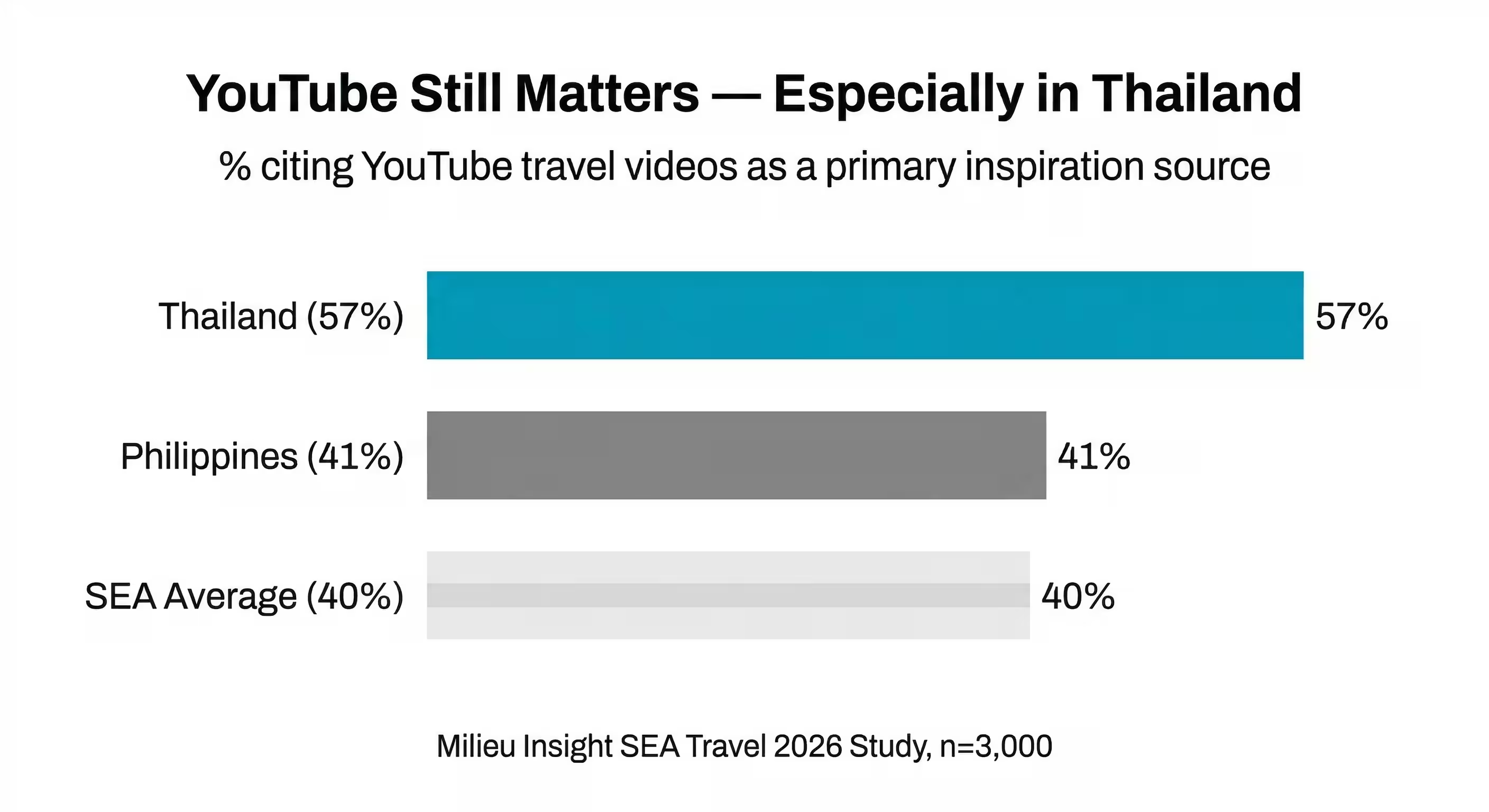
In Thailand, 57% of travellers use YouTube travel videos as a primary inspiration source, rivalling social media and far exceeding the regional average of 40%. In the Philippines, the figure stands at 41%. In these markets, long-form content — detailed destination walkthroughs, accommodation reviews, and day-in-the-life vlogs — continues to shape travel decisions in a meaningful way.
This Is Not Just Discovery. It Is Destination-Making.
What makes social media uniquely powerful is that it doesn't just influence where people go — it actively creates the destinations worth going to. A beach featured in a viral TikTok becomes a must-visit overnight. A café with the right aesthetic turns into a talked-about site. A photogenic neighbourhood draws visitors who may never have discovered it through a guidebook.

This dynamic is especially visible in Vietnam, where 16% of travellers cite social media influence and "Instagrammable" spots as a key attraction factor, second only to Indonesia at 19%. These travellers are not just documenting their trips after the fact — they are choosing destinations based on how they will appear on social media before they even book.
The Trust Hierarchy Has Shifted
One of the more nuanced findings is how social media has reshaped trust in travel decision-making. Friends and family — long considered the gold standard — now rank below social media in most markets. In Thailand, the contrast is particularly stark: 69% cite social media, compared to just 30% who rely primarily on personal recommendations.
This does not signal a decline in trust, but rather a transformation of it.
Social media has successfully replicated personal trust at scale. A travel creator with a loyal following feels like a trusted friend — someone whose taste is familiar, whose recommendations feel tested, and whose experiences can be vicariously explored before booking. Meanwhile, traditional travel agents are cited by just 16% of travellers as a primary inspiration source, and only 7% primarily book through them. The shift away from traditional intermediaries is well underway.
That said, pre-packaged tours still hold appeal, particularly in Indonesia (17%) and Vietnam (20%), suggesting that while inspiration has gone digital, some travellers still value human curation at the booking stage.
The Road Ahead
Social media's influence on travel will only intensify as digital-native travellers come of age. Vietnam and Thailand — markets with the highest social media influence — also have some of the youngest and most digitally engaged populations in the region. As they travel more, spend more, and share more, the feedback loop between content and behaviour will accelerate.
For the industry, this presents both opportunity and responsibility. TikTok told millions of people where to go this year. The question for 2027 is: who will shape what it says next?
This article draws on findings from Milieu Insight's SEA Travel 2026 Study, conducted between 2–9 February 2026, across six Southeast Asian markets with 3,000 respondents (500 per market). For the full dataset, contact sales@mili.eu.

Author
Milieu Team
At Milieu, we’re a team of curious minds who love digging into data and uncovering what drives people. Together, we turn insights into stories—and stories into action. We also run on coffee, deadlines, and the occasional meme.
Latest Insights